

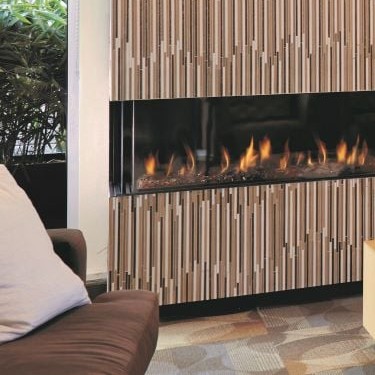
Ortal Corner Gas Fireplace Selection and Installation
A fireplace that turns a corner lets the fire become part of the room’s architecture. Ortal Corner fireplaces combine a front view with an adjoining left- or right-side view, bringing the flame into sight from a neighboring seating area or approach. They are a good choice when a solid-sided fireplace would hide the fire from part of the room.
Serving the Triangle and surrounding Central North Carolina communities.
These are complete built-in gas fireplaces with their own fireboxes. Chimneys Plus can help you compare Signature-burner models with Wilderness versions, whose specialized gas-fed logs create flames through the logs themselves. The burner choice changes the fire appearance and specifications, not just the decorative accessories.
Choosing the view and flame
Choosing left-side or right-side glass is an early design decision. We look at where you sit, how you enter the room and what the fireplace enclosure will conceal. An L-shaped fire view differs from the open-ended view of a three-sided fireplace, so the best choice depends on your floor plan.
The main current Corner size families include 25H, 44, 51, 60, 68, 77 and 98, with selected taller H and HH versions. The Signature collection also includes 40H70 and 75 formats. Wilderness versions extend through selected 77-size formats rather than duplicating every Signature model. We confirm the exact combination of size, viewing height, burner and barrier before finalizing the design.
Installation and representative specifications
The sealed direct-vent firebox draws combustion air from outside and exhausts outdoors, rather than using the room’s conditioned air for combustion. Its enclosure still needs manufacturer-required heat-release openings, clearances and service access. Screens and double-glass barriers have different installation and electrical implications; neither means the fireplace should be treated as a cool surface.
For the 44-series example:
- Corner 44 Signature published viewing area: 46 5/16 inches wide by 15 3/4 inches high. Consult its drawings for each glass face and the installed footprint.
- Signature 44/44H input: natural gas 22,789–37,167 BTU/hour; propane 25,113–35,316 BTU/hour.
- Wilderness 44/44H input: natural gas 15,696–32,163 BTU/hour; propane 21,400–31,400 BTU/hour.
- Standard 44-series venting: 5-by-8-inch coaxial direct vent.
- Electrical supply for these 44-series models: 120 volts, 15 amps, 60 Hz, through the required duplex receptacle.
- Screen or double-glass heat barriers and approved optional systems must be matched to the selected model.
The input figures describe fuel consumption, not delivered heating output. Other sizes have different specifications. We size the installation for the room rather than assigning a square-foot claim to the whole family.
Manufacturer product information: Ortal Corner 44 and Ortal Wilderness collection.
Plan the installation with Chimneys Plus
As an authorized Ortal dealer, Chimneys Plus helps you coordinate the fireplace with the room design. We handle or coordinate gas piping, required electrical work and permitting. The Chimneys Plus team includes CSIA- and NFI-certified professionals. Together with our North Carolina general contractor and fuel-piping licenses, these qualifications reflect our commitment to knowledgeable fireplace installation and service.
Contact Chimneys Plus to compare Corner configurations and plan the right flame view for your home.
Current specifications
- Efficiency (AFUE), Signature 44: 77.8% natural gas, 81.4% propane
- Heat barrier: double glass or micro mesh screen; interiors Black Reflective Glass or Standard Matte
- Wilderness 44 log sets: Short Driftwood, Birch, Valley Oak; controls remote, WiFi, wall switch; AFUE 79.7% NG, 80.4% LP
- Fuel: natural gas or propane
- Double glass, power vent and interior lighting units must run on the AC adapter and will not operate on batteries alone
Source: manufacturer product page. Specifications can change with new model years, so we confirm them against the current documents before you buy.
Related products and services
- Valor LX2 Gas Fireplace
- Valor LX1 Pier Gas Fireplace
- Valor L1 See-Thru Gas Fireplace
- All fireplaces
- Custom fireplace design and installation
- Gas line installation
- GasCheck annual gas fireplace service
- Financing options
Frequently asked questions
Where does an Ortal Corner fireplace work best?
It suits a wall end or corner where an adjoining side view brings the fire into another sightline. We help determine whether left- or right-side glass works better with the room.
What is the Wilderness option on an Ortal Corner fireplace?
Wilderness uses a dedicated burner and specially designed gas-fed logs. Signature models use a different burner with their own approved decorative media. We help you compare the two flame styles without assuming their inputs or accessory choices are identical.
Can an Ortal Corner fireplace operate during a power outage?
Only an approved battery-capable configuration should be considered for that purpose. Double-glass, power-vented and interior-lighting configurations require AC power, and other electrical options can also prevent battery operation. Chimneys Plus checks the precise model and accessories before making an outage-heat recommendation.
Does an Ortal Corner fireplace need electrical work?
The current 44-series manuals require a 120-volt duplex receptacle, even though some basic configurations may support battery operation. We coordinate required electrical work and keep the components accessible for service.
Can I install a television above an Ortal Corner fireplace?
Possibly, with the correct heat-release design, clearances and television installation. We assess the finished enclosure and the equipment’s requirements. Cooling features do not replace those requirements.
Will Chimneys Plus handle gas piping and permits for an Ortal Corner fireplace?
Yes. We confirm gas capacity and handle or coordinate the piping work, then handle applicable permits. A switch-out still needs permitting review even when a gas line is already present.
What service does an Ortal Corner fireplace require?
Schedule qualified inspection and maintenance at least annually. That includes the burner and pilot, glass and seals, venting and required airflow passages. The approved heat barrier must stay in place during operation, and media placement must follow the selected burner’s instructions.